
A portable fire extinguisher is a safety device that if used properly, will help extinguish and control incipient fires during an emergency. Every home should have at least one fire extinguisher on hand and someone that knows how to use it. Since there are several classes of fires there are also several types of fire extinguishers that have specialized abilities to control each class. In addition to the class rating, a fire extinguisher will typically also have a numerical rating that represents the firefighting effectiveness of the device.
 Before explaining the different classes of fires, it’s probably a good idea to first explain how fires start. The fire tetrahedron provides an easy to remember illustration of the components necessary for combustion. Heat is needed to increase the temperature necessary for ignition. Oxygen is needed to sustain the fire. Fuel is needed to support the fire and a chemical reaction is needed to make the initial spark. Taking away even one of these elements will stop a fire in its tracks. Also remember that many fires can be combinations of the fire classes below.
Fire Classes
 Class A Fires are fires that use ordinary combustibles as their fuel. If items such as wood, paper, cloth, rubber, some plastics, and/or trash combust, it is considered class A. Class A fires are the most common and usually the easiest to contain. They also are classified by their ability to produce ash. Class A fires can be controlled by using either water, foam, halotron, or any dry chemical extinguishers.
 Class B Fires are fires that involve flammable liquids and gases. Gasoline, paint, paint thinner, propane, butane, kerosene, acetylene, lacquer, oil based liquids, and alcohol are all considered class B fire fuels. Class B fires can be controlled with either foam, halotron, dry chemical, or CO2 extinguishers. Water should never be used on this type of fire. It will only cause the fuel to splash and possibly spread.
 Class C Fires are fires that involve energized electrical wiring and equipment. Class C fires are unique because as soon as the the electricity is cut or dies, it becomes one of the other fire classes. Once again water should not be used to control this type of fire. Since water can carry a current, the risk of electrocution is eminent. Class C fires can be controlled with CO2, Halotron, and dry chemical fire extinguishers.
 Class D Fires are fires that involve combustible metals like magnesium, potassium, aluminum, titanium, and sodium. Most of these metals will typically burn at higher temperatures and can react violently with water or other chemical agents. According to the NFPA, “Class D fires can be controlled with dry powder extinguishing agents based on sodium chloride or other salts; also clean dry sand”. Dry powder should not be confused with dry chemical. Trying to extinguish a metal fire with a dry chemical extinguisher will only result in spreading the fire. Simply put, this is a job for a fire professional.
 Class K Fires are fires involve cooking & vegetable oils, grease, and fats. It can be considered a sub category of a class B fire but since they typically burn at higher temperatures they have been given their own distinction. Class K fires can be controlled with either a wet or dry chemical extinguisher. These types of chemical extinguishers can quickly change the burning oils into a non-combustible soap through saponification.
Fire Extinguisher Types
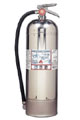 Water Fire Extinguishers can be broken down into two types: air pressurized and mist. The air pressurized version (APW) uses pressure and water to suppress the heat of a fire. They should only be used for class A fires. The water mist extinguisher is class A and C rated because the fine mist is non conductive. Water extinguishers are often used in hospitals, offices, and schools and typically have a silver or chrome finish.
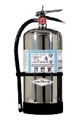 Foam Fire Extinguishers can suppress a fire by separating the oxygen from the other elements. They contain pressurized air and foam that should only be used on class A & B fires (some D). The foam actually floats atop the flammable liquids and acts as a barrier to prevent further burning. There are a variety of foam options and many current foam based extinguishers offer foam that is non-toxic and biodegradable.
 Carbon Dioxide (CO2) Fire Extinguishers can suppress a fire by removing the oxygen and since they dispense cold CO2 they eliminate the heat as well. They are approved for class B & C fires and are environmentally friendly. They leave little to no residue upon discharge but are limited in their range. Are a popular choice in contaminate free areas such as computer rooms and laboratories. After a CO2 extinguisher has been discharged, you won’t even be able to tell.
 Multi-Purpose Dry Chemical Fire Extinguishers are the all around work horses of the fire extinguishing community. They have the ability to fight A, B, & C class fires by effectively smothering them, which in turn separates the oxygen and fuel. The key ingredient to these types of extinguishers is ammonium phosphate. It is a non-conductive, corrosive agent that does a good job of suppressing fire at the cost of making a complete mess.
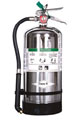 Class K Fire Extinguishers are typically needed for controlling kitchen fires caused by cooking oils, grease, and fat. They can be either wet chemical or dry chemical and most contain a potassium based agent for suppressing fire. Since cooking oils get to extremely high temperatures a new fire class and extinguishing method was necessary. According to the NFPA “over 90% of all the residential fires in the US start in the kitchen”.
 Class D – Dry Powder Fire Extinguishers are needed for combustible metals like magnesium, potassium, aluminum, titanium, and sodium. There are basically two types. A Sodium chloride version and a copper based powder version. The copper based version is the only known lithium fire extinguishing agent that will cling to vertical surfaces. This type of extinguisher should not be used for suppressing any other type of fire.
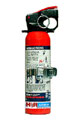 Halogenated and Clean Agent Fire Extinguishers contain halocarbon agents (halon 1211 in older models). They are effective in controlling A, B, and sometimes C class fires and are designed to interrupt the chemical reaction of the fire triangle. Halocarbon agents replaced halon 1211 within the last 8 years and are considered the greener and more environmentally accepted agent. By 2010, halon 1211 will no longer be produced.
Fire Extinguisher Codes – Letters & Numbers
Fire extinguishers use a classification system that uses letters and numbers. The letter represents the class of fire the extinguisher can be used on. The number represents the effectiveness. For instance, if a fire extinguisher has a 1-A rating, it can control class A fires and can dispense the equivalent of 1.25 gallons of water. A 2-A rated extinguisher controls class A fires and contains the equivalent of 2.50 gallons of water.
The effectiveness of class B extinguishers are measured a bit different. Class B extinguisher ratings are based on square footage. So a 10-B rating would allow the extinguisher to control a fire of 10 square feet.
Only class A & B extinguishers have a numerical rating that goes along with the letter. The other fire classes and their extinguisher equivalents will only display the letter.
So what do you think this code means on a fire extinguisher?
2-A:10-B:C
Answer: This extinguisher is approved for A,B, & C class fires. It has the equivalent of 2.50 gallons of water for class A fires, and has a 10 square foot covering distance for class B fires. It also uses a non-conductive agent that is good for class C fires.
How to Use a Fire Extinguisher – Training
If a fire is discovered, before attempting to use a fire extinguisher, a few things must first be completed.
- Get yourself and others out of immediate danger.
- Call 911 and sound the alarm if possible.
Only use a fire extinguisher if the fire is very small and you know how to carry out extinguishing it safely. Ask yourself these questions.
- Do you know what is burning?
- Do you have the appropriate extinguisher to put out the fire?
- Is the fire small enough to be controlled? Is it spreading?
When using a fire extinguisher, remember this simple acronym P.A.S.S.
- Pull the pin – pulling the pin frees the extinguisher lever.
- Aim at the base of the fire – Spraying the base covers the fuel.
- Squeeze the handle/lever – This releases the extinguishing agent.
- Sweep back and forth over the base of the fire.
When using a fire extinguisher it’s also important to remember to position yourself with an exit at your back. Having an escape route is important in case the fire spreads unexpectedly. And even if you manage to put out the fire call the fire department anyway. Sometimes a fire can reignite when it appears to be extinguished.
Fire Extinguisher Maintenance
Fire extinguishers should be checked at least once per year to make sure they operate effectively and safely. Be sure to check:
- The extinguisher is in a readily accessible area.
- The extinguisher pressure is at the recommended level.
- The extinguisher nozzle is not clogged or obstructed in any way.
- The extinguisher is free from dents, leaks, and rust.
- The extinguisher pin is still in place.
If a fire extinguisher is ever used it should be refilled, replaced, or serviced immediately.